
The SYNERGYS project – Systems for Energy Synergy – is a research initiative focused on harnessing different forms of geothermal energy and other renewable sources and integrating them into existing energy systems. Within the RINGEN research infrastructure at the former Jiří of Poděbrady Barracks in Litoměřice, a unique test site is being developed that connects shallow and deep geothermal boreholes, an underground thermal energy storage facility, photovoltaic systems, and green hydrogen production technologies into a single, integrated whole. The goal is to verify, in one location, how these resources can be smartly combined into a predominantly near-zero-emission energy system that will help replace part of the fossil fuels used for local heating in the future and increase energy self-sufficiency. The project is hosted by the RINGEN scientific research centre, opened in 2019, which—thanks to SYNERGYS and other follow-up projects—is gradually becoming one of the key components of the ongoing energy transition in the Ústí nad Labem Region.
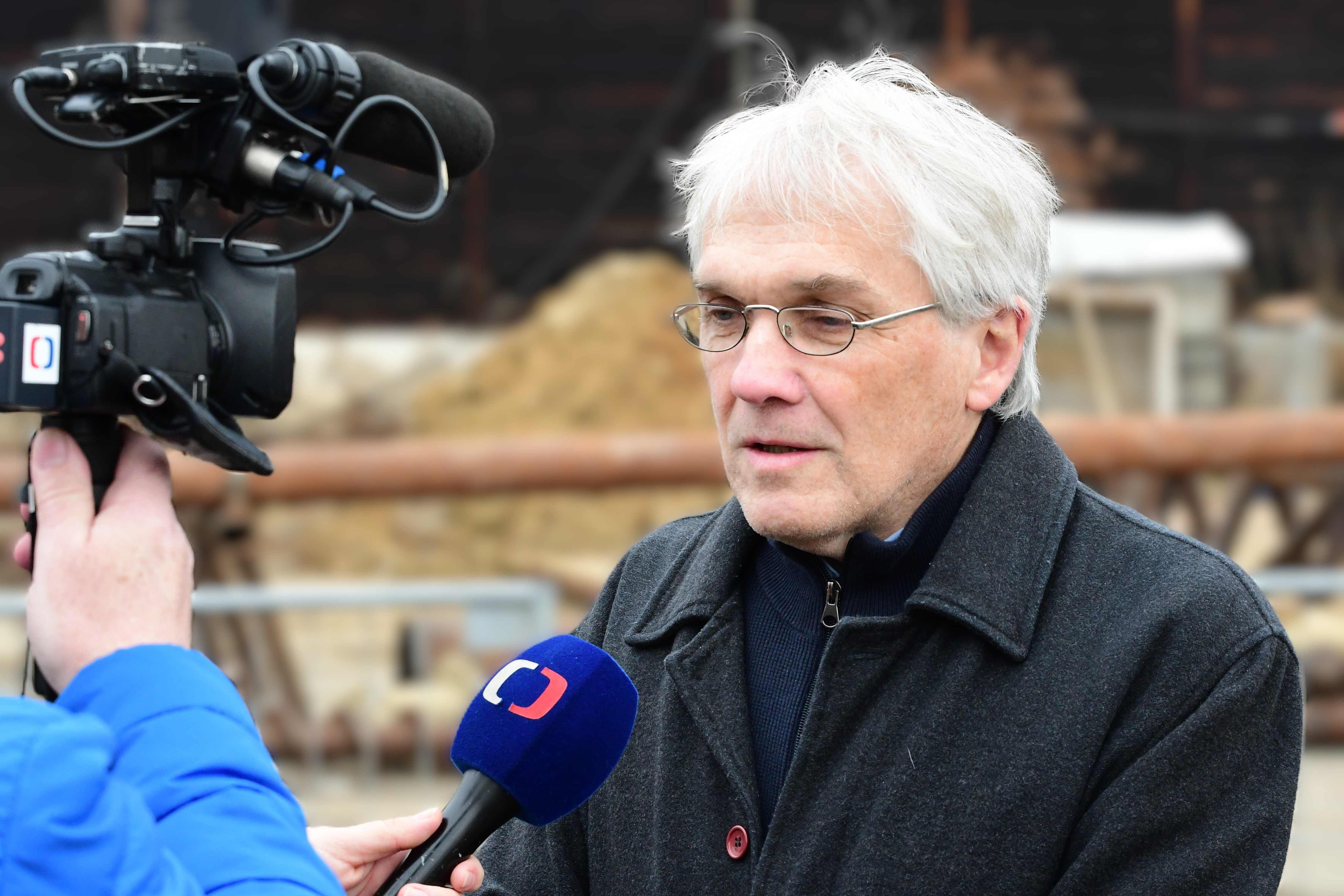
As 2025 draws to a close, we asked the project’s principal investigator, Professor Tomáš Fischer of the Faculty of Science, Charles University—which, together with its partners, is leading the SYNERGYS project—for a year-end interview.
The year 2025 was relatively eventful for the project, both in terms of research measurements and borehole drilling, and in terms of activities for the wider professional community and the general public. Let’s start at the beginning. In order to refine our understanding of the geological structure of the test site, an extensive survey was carried out in the Litoměřice and Žitenice area in autumn 2024, during which vibrations at the surface were generated using heavy trucks. In 2025, you evaluated the measurements. Did anything emerge that surprised you in any way within the ongoing research activities?
A: One surprising finding was that we recorded seismic reflections even at greater depths, which is not common given the character of the rocks there. In crystalline basement rocks that do not have a layered structure, pronounced reflective interfaces that would generate seismic waves detectable at the surface are generally not expected.
Very positive, too, is the comparison of these seismic measurements with magnetotelluric data—i.e., measurements of the electromagnetic field that provide information about the electrical conductivity of rocks. The two methods show a strong correlation: interfaces visible in the seismic data correspond well with those indicated by the magnetotelluric data. This is very good news for us, and it also fits well with the geological profile.
Q: And what does that profile look like?
A: The evaluation showed, among other things, a very clearly visible boundary between the sedimentary fill of the Palaeozoic (Carboniferous) basin and the older, pre-Palaeozoic basement. We are particularly interested in the geometry of this boundary—its undulation, its dip—as well as other, deeper structures. We also identified features indicating the presence of the Litoměřice Fault, a well-known geological structure separating the Saxothuringian Zone from the Teplá–Barrandian Unit. Its course is important for us in terms of the future placement of deep geothermal boreholes and heat exchangers.
In the seismic data, it appears as a disruption of seismic reflections from the basement beneath the Carboniferous basin, and it seems that its dip is probably different from what had previously been assumed.
Q: Did the subsurface reveal, in some respects, “a different face” than you originally expected from earlier models?
A: Definitely—also in connection with research into shallow geothermal energy. This is not directly related to the seismic surveys, but rather to the successful drilling of two exploratory boreholes within the international PUSH-IT project: a cored borehole (516 metres) and a hydrogeological borehole (202 metres).
Q: What specific information did these two boreholes provide?
A: They gave us detailed information about the geological sequences in the first several hundred metres, as well as their hydraulic transmissivity and other properties. The hydrogeological borehole is open, which allows us to measure groundwater flow, deploy various types of probes, and monitor its characteristics over the long term. In 2026, five more monitoring boreholes of this type will be drilled. The other one is a cored borehole. It provided valuable information from the drill core; it was then fitted with an optical cable and cemented. It will continue to serve as a geothermal monitoring borehole—primarily to track changes in temperature in the rock basement in connection with future thermal energy storage. The boreholes also demonstrated that the fill of the Czech Cretaceous Basin is highly variable, containing both highly permeable and less permeable zones.
Q: Is that a complication for future work?
A: It complicates the planning of an underground thermal energy storage facility to some extent—we need to identify intervals with lower permeability, which are more suitable for heat accumulation. At the same time, however, we are also considering alternative heat storage technologies—for example, storing heat in an aquifer rather than primarily in the rock mass. In other words, we want to turn a disadvantage for one technology into an advantage for another, which is, after all, one of the tasks of our research and testing.
Q: Following the first two shallow boreholes, the plan was to install the first borehole field to depths of up to 100 metres, which is intended to serve in the future as a large underground “battery” for the RINGEN building. This plan has encountered a slight delay. What was the reason?
A: Drilling work is a highly specialised activity that only a handful of entities in the Czech Republic are capable of carrying out. At the same time, we place very high demands on workmanship—higher than is usual in standard commercial projects.
We also often run into administrative obstacles that slow the process down. Sometimes we have to significantly extend or repeat a tender, because facts emerge during the process that were not known beforehand—for example, regarding the capabilities of the companies applying. We need to learn from this and eliminate these problems in the next period, because dozens more demanding tenders still lie ahead of us.
Q: This year, the plan is to implement borehole fields 200 to 400 metres deep. Put simply, these are deeper “reservoirs” for storing residual heat from solar panels and the hydrogen system. Will the above-mentioned delay jeopardise the implementation timeline for these fields? Could the individual stages “collide” in an unfortunate way?
A: These three activities are planned independently of one another, including in terms of their function. The 100-metre borehole field is intended to provide heating for the RINGEN centre building; the tender has already been completed, and drilling will begin in January. The other two borehole fields, at 200 and 400 metres, are intended for residual heat storage. They will be separate contracts, but they will build on results from the earlier boreholes and measurements—so there can be an impact. If there is a more significant delay, we will likely implement both borehole fields at the same time, which should allow us to catch up. As I mentioned, we also need to decide which storage method we will ultimately choose—this will also be a task for our international team, which will start collaborating on the project in January.
Q: In 2026, preparation is also due to begin on documentation for tenders for contractors for deep geothermal boreholes. According to the assumptions, implementation should start at the beginning of 2027. How demanding is such a tender?
A: It is an entirely unique task. Only a few companies in Europe—just one in the Czech Republic—can drill boreholes of this depth, i.e., around three kilometres and more. In addition to the depth itself, we place emphasis on drilling accuracy and on a range of follow-up research work, such as hydraulic stimulation and potential hydraulic interconnection of the boreholes.
We have therefore devoted maximum attention to selecting a contractor, and the process has been underway for more than a year. It started with preliminary market consultations in autumn 2024, even before the grant was awarded; otherwise, we would have had no chance of meeting the tight schedule. We expect the final tender specifications to be prepared by a specialised engineering firm with experience in similar projects. A public tender for these services is currently in progress.
Q: In your view, is geothermal energy perceived more positively in the Czech Republic than in the past, also in connection with the recent energy crisis? Do you feel geothermal energy is gradually becoming a “full-fledged player” alongside photovoltaics and other renewables?
A: There has definitely been a shift. This is also reflected in the energy policy of the outgoing government, which placed strong emphasis on ensuring secure and stable energy sources. Russia’s aggression also showed that highly centralised energy systems dependent on imported fossil fuels are more vulnerable than decentralised systems based more on local resources.
Demand for solar energy and photovoltaics has increased significantly. At the same time, I sense that people better understand the benefits of using heat from the ground via heat pumps. Today, the air-to-water heat pump segment dominates; however, ground-sourced energy is substantially more reliable and more efficient in terms of supply stability.
Q: But it is also significantly more expensive…
A: Yes. That is why, looking ahead, it is crucial to focus on reducing the costs of drilling—and that is one of the aims of our projects.
Q: What would you like to see from the new government? For example, the adoption of legislative measures that would make it easier to implement technically demanding projects of this type?
A: Overall, I still see significant room for improvement in the legislative environment—especially with regard to drilling shallow boreholes for heat pumps at family houses. For example, the issue of property boundaries and extracting heat from neighbouring parcels is not adequately addressed. In many Western countries, this is covered by legislation; here, it is not yet, and it will have to be resolved as the number of such sources increases.
Q: And what about deep geothermal energy?
A: Here it is still a research activity with its own specifics; in its case, legislative changes are not as crucial. Rather, it is about managing the risks associated with drilling operations and hydraulic stimulation. Many countries have therefore created various types of guarantees for companies and investors in general, and the first borehole is typically financed to a large extent from a risk fund or through 100% subsidy support—as is the case, for example, in Poland. Thanks to this instrument, around three dozen new deep geothermal sources are expected to be implemented there; unfortunately, the Czech Republic is not currently anywhere near that.
To a considerable extent, it will therefore depend on priorities in the energy sector and on politicians’ ability to understand that geothermal energy is a competitive energy source and highly significant for the decarbonisation of Czech district heating. We do not have another renewable source available in such quantities. However, strategic decisions are needed, pilot projects must be supported, and systematic support must also be established—for example in the form of accessible data on the geological conditions of the Czech Republic, which is noticeably lacking. Without such data, the development of geothermal energy will proceed slowly.
Q: One of the aims of the SYNERGYS project is also to raise awareness of geothermal energy and geosciences as such. Is that working?
A: Within SYNERGYS, approximately two dozen outreach events have already taken place—for example for pupils and students from secondary schools and universities, and for seniors. A public hearing was held, as well as an Open Day organised in cooperation with Česká spořitelna, attended by more than a hundred visitors. Events have also been held for geothermal professionals, companies, state administration and local government. For the professional community, the most significant were probably the March workshop for drilling companies and the nationwide conference on shallow geothermal energy in November. It attracted considerable attention from experts and developers, as well as from the media. We want to pursue a similar direction in 2026. In January, for example, RINGEN will host a field visit by CTU students interested in geotechnics.
Step by step, we are fulfilling this mission—not only in the context of the Czech Republic, but also at the European level. That is also why we are now a sought-after partner for geothermal projects across Europe, and we more often run up against capacity limits of our expert and project team—so we have to decline a number of cooperation offers.
