

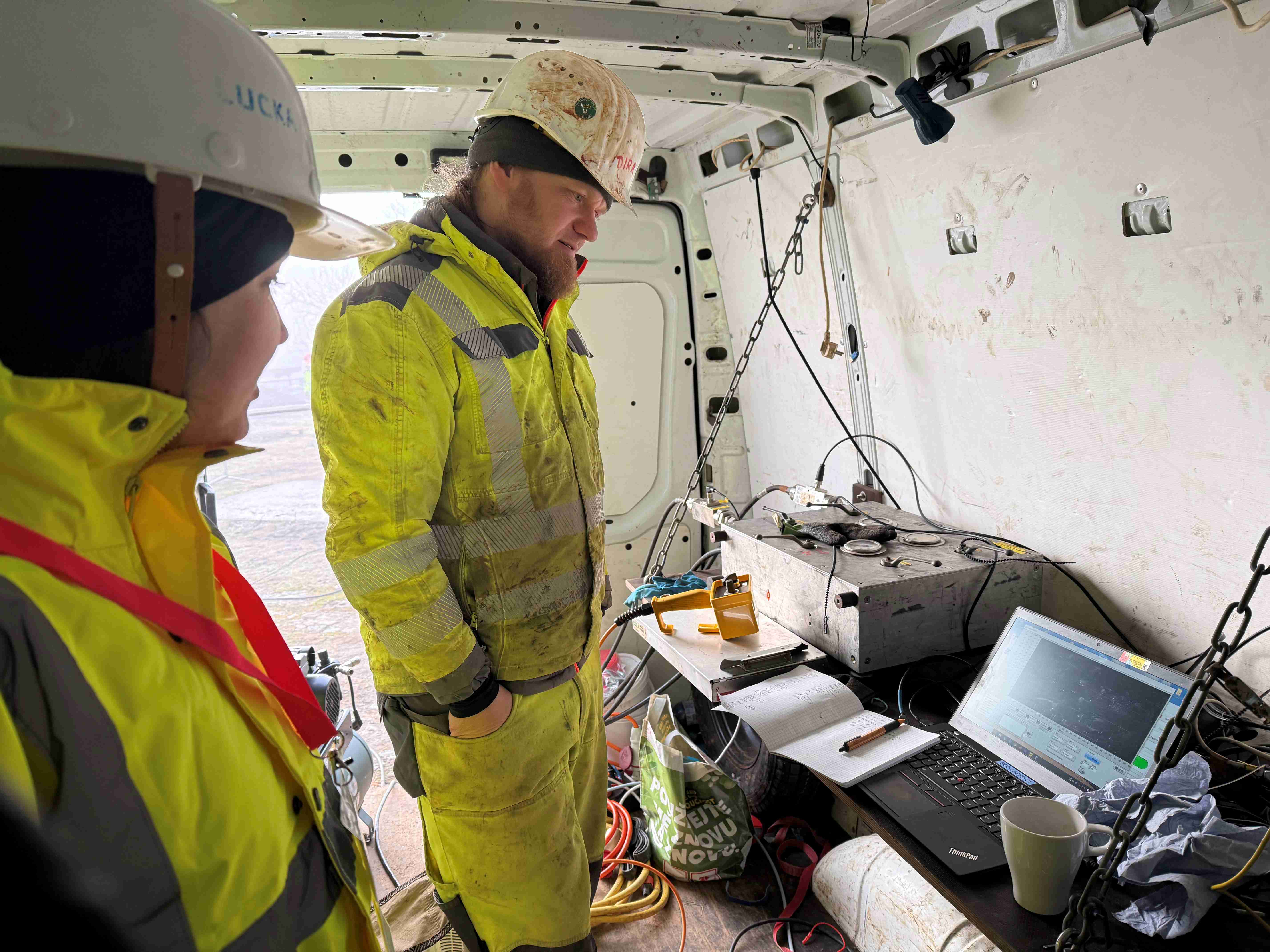
It is a specialised measurement being carried out by international experts from Germany and Switzerland in the deepest of the research boreholes, which was drilled as early as 2007 as part of the verification of the geological structure for the use of geothermal energy. The measurement is expected to provide scientists with important information on elastic stress within the rock mass, which is one of the key parameters for the final design of deep geothermal wells currently being prepared and for the creation of a geothermal heat exchanger at depths of up to 3.5 km—one of the greatest challenges of the long-term research into the use of geothermal energy and other renewable sources in Litoměřice.
The test consists of pressurising a selected section of the borehole wall using a special probe equipped with pressure sensors and sealing elements, between which water is injected into a one-metre interval. “We monitor the pressure–time curve of the water and look for the moment of a sudden drop in pressure. At that point, the water opens a new pathway and we measure its pressure, which corresponds to the minimum rock stress. We will then repeat this procedure at other depth intervals,” outlined Tomáš Fischer, the principal investigator of the strategic SYNERGYS project, led by Charles University together with other partners.
The test is being conducted in an exploratory borehole that Charles University has leased from the City of Litoměřice for further research and which, at a depth of 2.1 km, remains the deepest geothermal exploratory borehole in the Czech Republic. At present, however, it is accessible only to approximately 1,700 metres, as its lower section has naturally collapsed over the years. For the measurement itself, the interval between 1,150 and 1,700 metres is crucial, as the borehole has smooth walls there and is suitable for testing—something confirmed a few days ago by a verification coring survey, which confirmed both good accessibility of the borehole and the presence of fractures.
After 10 to 15 measurements have been completed, a final survey will be carried out using an acoustic camera. “The image will show where fractures formed in the borehole, how they have changed and what their orientation is. It is precisely from the orientation and size of the fractures that we can determine the direction of the principal horizontal stress in the rock,” explains geophysicist Lucie Janků from the Faculty of Science, Charles University. The measurement results will then help refine assumptions about the expected behaviour of the rock at the target depth, which is currently inaccessible and whose composition can only be estimated, as well as inform the orientation of the planned deep boreholes.
Preparing the test took several days. The specialised international team arrived on site on Monday. It then took two days to lower the measuring apparatus to the target depth. According to the experts, the measurements launched today will proceed relatively quickly, and the work is expected to be completed by tomorrow or Friday. “This will be followed by a second control coring survey and then data evaluation, the results of which should be available in approximately a month,” Professor Fischer added.
